Frog legs
Frog legs are a culinary delicacy made from the legs of frogs. They are particularly popular in the cuisines of France, Southeast Asia, and the Southern United States. The most commonly eaten species of frog is the bullfrog, although other species are also consumed.
Culinary use[edit]
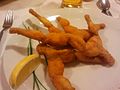
Frog legs are rich in protein, omega-3 fatty acids, vitamin A, and potassium. They are often described as tasting like chicken because of their mild flavor, with a texture most similar to chicken wings. The cooking methods can vary widely, but they are often breaded and fried, or grilled. In French cuisine, they may be prepared with garlic and parsley butter and served with a slice of lemon.
Cultural significance[edit]
In France, frog legs are traditionally associated with the region of Burgundy, but they are consumed all over the country. They are also a common dish in Chinese and Indonesian cuisine. In the United States, frog legs are most commonly found in the South, particularly in the state of Louisiana.
Health concerns[edit]
There are some health concerns associated with eating frog legs. Frogs are known to be carriers of various diseases, including salmonella and parasites. Therefore, it is important to cook frog legs thoroughly to kill any potential pathogens. Additionally, the over-harvesting of frogs for their legs has led to ecological concerns.
See also[edit]
 | |
|---|---|
 |
 |
| This medical article is a stub. You can help Wikipedia by adding missing information. |
-
 Frog legs
 -
 Frog legs
 -
 Frog legs
 -
 Frog legs
 -
 Frog legs
 -
 Frog legs
 -
 Frog legs
 -
 Frog legs
 -
 Frog legs
 -
 Frog legs
 -
 Frog legs
 -
 Frog legs


Ad. Transform your health with W8MD Weight Loss, Sleep & MedSpa

Tired of being overweight?
Special offer:
Budget GLP-1 weight loss medications
- Semaglutide starting from $29.99/week and up with insurance for visit of $59.99 and up per week self pay.
- Tirzepatide starting from $45.00/week and up (dose dependent) or $69.99/week and up self pay
✔ Same-week appointments, evenings & weekends
Learn more:
- GLP-1 weight loss clinic NYC
- W8MD's NYC medical weight loss
- W8MD Philadelphia GLP-1 shots
- Philadelphia GLP-1 injections
- Affordable GLP-1 shots NYC
- Budget GLP-1 shots
|
WikiMD Medical Encyclopedia |
Medical Disclaimer: WikiMD is for informational purposes only and is not a substitute for professional medical advice. Content may be inaccurate or outdated and should not be used for diagnosis or treatment. Always consult your healthcare provider for medical decisions. Verify information with trusted sources such as CDC.gov and NIH.gov. By using this site, you agree that WikiMD is not liable for any outcomes related to its content. See full disclaimer.
Credits:Most images are courtesy of Wikimedia commons, and templates, categories Wikipedia, licensed under CC BY SA or similar.
Translate this page: - East Asian
中文,
日本,
한국어,
South Asian
हिन्दी,
தமிழ்,
తెలుగు,
Urdu,
ಕನ್ನಡ,
Southeast Asian
Indonesian,
Vietnamese,
Thai,
မြန်မာဘာသာ,
বাংলা
European
español,
Deutsch,
français,
Greek,
português do Brasil,
polski,
română,
русский,
Nederlands,
norsk,
svenska,
suomi,
Italian
Middle Eastern & African
عربى,
Turkish,
Persian,
Hebrew,
Afrikaans,
isiZulu,
Kiswahili,
Other
Bulgarian,
Hungarian,
Czech,
Swedish,
മലയാളം,
मराठी,
ਪੰਜਾਬੀ,
ગુજરાતી,
Portuguese,
Ukrainian
