Fluorescence
Fluorescence is a physical phenomenon that is often used in biological and chemical research. It is the emission of light by a substance that has absorbed light or other electromagnetic radiation. The emitted light usually has a longer wavelength, and therefore lower energy, than the absorbed radiation.
Overview[edit]
Fluorescence occurs when an orbital electron of a molecule, atom, or nanostructure, relaxes to its ground state by emitting a photon from an excited singlet state. The most striking examples of fluorescence occur when the absorbed radiation is in the ultraviolet range of the spectrum, and thus invisible to the human eye, and the emitted light is in the visible range.
Applications[edit]
Fluorescence has many practical applications, including mineralogy, gemology, chemical sensors (fluorescence spectroscopy), fluorescent labelling, dyes, and biological detectors. In biology, the fluorescence microscope is used to study the distribution of substances in biological specimens.
Fluorescence in nature[edit]
Many substances in nature can fluoresce. For example, the skin, blood, and certain types of plants and minerals can emit light when exposed to ultraviolet light.
See also[edit]
References[edit]
 | This medical article is a stub. You can help WikiMD by expanding the page. |
-
Fluorescence
-
Fluorescence
-
Fluorescence
-
Fluorescence
-
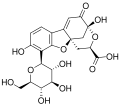 Fluorescence
 -
Fluorescence
-
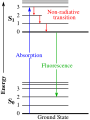 Fluorescence
 -
Fluorescence
-
Fluorescence
-
Fluorescence
-
Fluorescence
-
Fluorescence


Medical Disclaimer: WikiMD is for informational purposes only and is not a substitute for professional medical advice. Content may be inaccurate or outdated and should not be used for diagnosis or treatment. Always consult your healthcare provider for medical decisions. Verify information with trusted sources such as CDC.gov and NIH.gov. By using this site, you agree that WikiMD is not liable for any outcomes related to its content. See full disclaimer.
Credits:Most images are courtesy of Wikimedia commons, and templates, categories Wikipedia, licensed under CC BY SA or similar.
Translate this page: - East Asian
中文,
日本,
한국어,
South Asian
हिन्दी,
தமிழ்,
తెలుగు,
Urdu,
ಕನ್ನಡ,
Southeast Asian
Indonesian,
Vietnamese,
Thai,
မြန်မာဘာသာ,
বাংলা
European
español,
Deutsch,
français,
Greek,
português do Brasil,
polski,
română,
русский,
Nederlands,
norsk,
svenska,
suomi,
Italian
Middle Eastern & African
عربى,
Turkish,
Persian,
Hebrew,
Afrikaans,
isiZulu,
Kiswahili,
Other
Bulgarian,
Hungarian,
Czech,
Swedish,
മലയാളം,
मराठी,
ਪੰਜਾਬੀ,
ગુજરાતી,
Portuguese,
Ukrainian


